The Bad Blintz Rat-catchers' Swindle
The Amazing Maurice and His Educated RodentsThe Bad Blintz Rat-catchers' Swindle is a layered deception: Maurice’s familiar rat-piper scheme brings him and the rats to a town already primed to fear rats, while the danger they uncover there is not simply a nuisance to be cleared away. The trick initially promises money; its more consequential turn is to expose how fear can be made profitable, and to force Bad Blintz to consider an agreement with the thinking rats it has treated as vermin.
The familiar trick, made bigger
The scheme is built on performance and a carefully managed impression of scale. Maurice has already decided that the group will try the trick once more, divide the money three ways, and make this final performance memorable. The rats accept the decision with relief, though they are not entirely comfortable with a grinning cat’s enthusiasm. Maurice wants them to make the town notice them: squeak, pull faces, and create the visible disorder that makes a rat plague seem real.
The mechanics depend on doing a great deal with very few rats. A single rat appearing in different places, squeaking, bathing in cream, or urinating in flour can persuade people that their town is overrun. After several days of such disturbances, the apparently magical piper arrives; rats then pour from holes and follow him out. The townspeople are impressed by the spectacle and do not stop to count how few rats have supposedly been removed. The deception’s secret, kept from its human audience, is that the rats and the piper meet Maurice outside town and solemnly count out the money together.
The last performance is also constrained by practical risks. The money is put back in its bag, buried beneath bushes, and kept out of town; the valuable highwayman’s horse is released rather than sold, because its ornate saddle and bridle could invite questions, government attention, or the Watch. The group is not merely inventing a plague: it is managing evidence, proceeds, and attention so that the appearance of a simple rescue can survive scrutiny.
Bad Blintz’s invitation and hidden danger
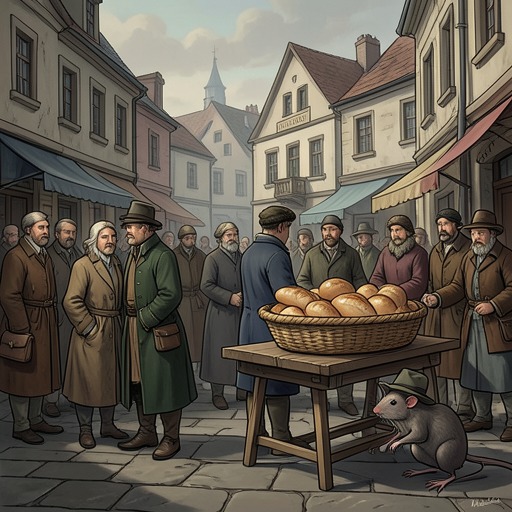
Bad Blintz seems to offer an unusually rich opportunity. A notice at the Rathaus advertises a reward of half a dollar for each rat tail, and Maurice predicts that the group will soon be sitting on a pile of gold. The town’s visible poverty complicates that promise: the market has few stalls, mostly selling used or unwanted goods. The reward suggests both a serious demand to remove rats and a striking mismatch between the town’s limited means and the price offered for proof of a kill.
The rat-plague performance works because it draws on a familiar public story: towns have heard of pipers who travel from place to place to rid them of rats. But the story hides the actual transaction. People see a nuisance, then a seemingly effective specialist; they do not see the cat and rats dividing the proceeds beyond town. The trick makes public belief its instrument, while the performers’ private cooperation supplies the truth behind the show.
The group’s encounter with the town also opens onto a more brutal use of rats. Maurice explains that rat-catchers have brought live rats to rat-coursing: men put them into a wooden ring with terriers, while the rats mostly run around in panic. His explanation distinguishes an individual rat, which may think and act bravely, from a frightened crowd whose members’ panic spreads through one another. That account gives the rats’ fear a concrete cause; it is not proof that rats cannot think, but a description of what terror does to a mass of animals.
From staged spectacle to real confrontation
The distinction between a manufactured plague and the rats’ actual predicament sharpens as the story proceeds. During a frightening disturbance, rats run past Peaches and Dangerous Beans gibbering; Dangerous Beans recognizes that they have forgotten how to talk. The loss of speech makes visible how collective terror can overwhelm the changed rats’ capacity for thought and communication. It is a collapse of the very difference the Clan asserts when Dangerous Beans says that its members are separate from the darkness and are not merely rats.
Darktan later turns that distinction into a call to coordinated action. Faced with a new, frightening presence below, he tells the squad that its strength lies in being rats with brains—able to think and not turn and run. He invokes the Dark Wood and the Bone Rat to give the danger a shape the squad can face together. The appeal does not deny fear; it attempts to prevent fear from dissolving the group into the same unthinking panic that Maurice described.
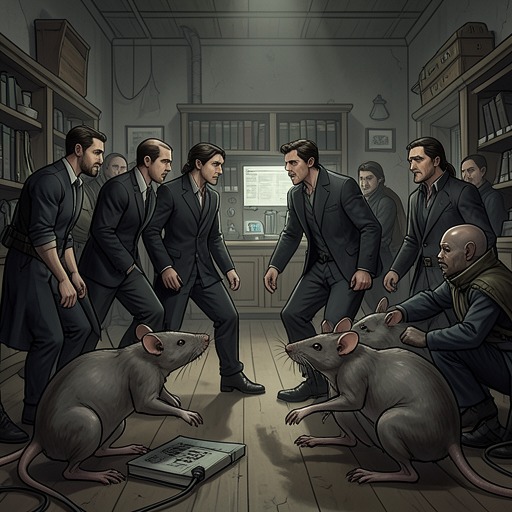
When the Clan finally attacks the enemy rats, its formation supplies a sharp contrast with that earlier flight. The rats move together in a line, close around an attacker like a fist, and then break into pairs to pursue scattered survivors. The fight is over within seconds. The Clan’s collective strength comes not from behaving as one mindless animal but from coordinated action by rats capable of holding a shared purpose. The staged plague’s old logic—make rats appear as a mass, then have the piper lead them away—has been overtaken by the harder question of whether humans will recognize the rats as people who can think and negotiate.
The contest and the changed terms
The piper’s public authority is challenged when Keith wins his pipe. The piper accepts the contest because winning will give him something to talk about, and the mayor even raises the possibility of offering his daughter’s hand in marriage as a prize. The exchange exposes how readily the contest is being treated as entertainment and how casually the mayor treats Malicia as part of its bargaining. Malicia protests, and the crowd—initially doubtful that a small, righteous boy could prevail—begins to support Keith, with a scruffy cat helping to stir that support from ground level.
Keith does not use his victory simply to take the piper’s livelihood away. He tells him to lead the rats out of town, proposes doing it together, and offers him half of the three hundred dollars. The piper explains that the fancy clothes, bullying, and high price are part of giving customers a show: without the appearance of magic, people might pay little more than a cheese lunch and a warm handshake. Keith keeps the performance and the payment but changes who shares the work and what the procession is for. His settlement makes cooperation more attractive than humiliating the defeated piper or pretending that the show has no economic value.
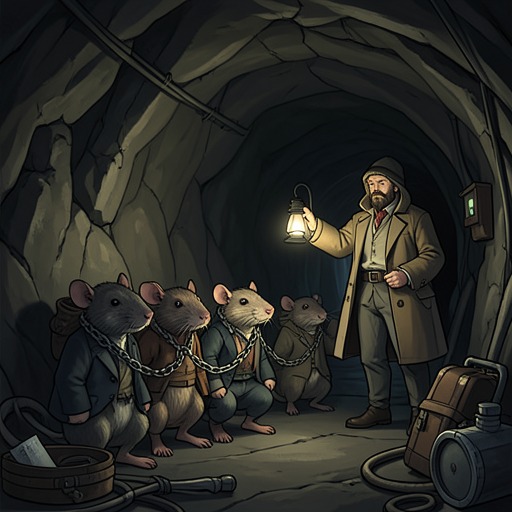
The same principle shapes the confrontation with the mayor. Darktan warns that driving rats away with dogs and brooms will not solve the problem: they live under the floorboards, know how to use fire, and know about poison. Rather than present this as a threat, Darktan calls it an opportunity and proposes reciprocal recognition: the mayor can pretend rats can think if Darktan will pretend humans can think too. Maurice then sketches a possible town in which people can ask rats to leave most of their food alone in return for an agreed share. His example is hypothetical, but its practical point is clear: rules can replace a recurring struggle when each side has reason to keep them.
Consequences and significance
The swindle’s consequences therefore exceed the initial division of money. Maurice’s performance depends on people mistaking a few coordinated rats for a plague, but the crisis forces Bad Blintz to confront the difference between a nuisance to be removed and a community capable of making terms. Keith’s arrangement with the piper shows how a contest can end without making the loser destitute; Darktan’s proposal extends that logic from individuals to the town and the Clan.
The event also sets two kinds of collective behavior against each other. Fear makes rats gibber, forget speech, and flee; shared identity and discipline let the Clan close ranks and act with purpose. The resolution does not rest on a claim that humans and rats have never been enemies. It rests on the possibility of changing the incentives and rules that keep them in conflict. In that sense, Maurice’s most important extension of the rat-piper trick is not another convincing spectacle: it is the suggestion that a town can choose cooperation before the rats return as a problem that cannot be managed by appearances.